
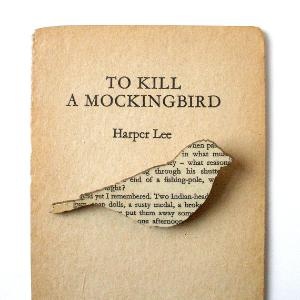
7:30 a.m. is too early for enthusiasm or coherent thoughts, but regardless, my morning ritual commences. I am attempting to straighten my paper-ridden desk, while my mind spins with the to-do list for the day. A blonde girl in first period walks up and starts chatting. She looks down at my piles which I can only suppose is shock and awe, and looks up to the ceiling, sighs, and says with a slow smirk, “T o
K i l l a M o c k i n g b i r d, I get it now!”
The line ‘F O R E V E R’ from the movie The Sandlot flashes through my mind and I wonder what she is talking about. She seems to be looking at the tattered To Kill a Mockingbird novel on my desk. I ask what she means, and she goes on to explain that last year she had a history teacher who also taught English and would always refer to this book and how lucky they would be to read it the next year.
The student said she could never figure out two things: first, why the author would pick such a dumb title for a book , ‘Tequila Mockingbird’, and second, why the heck we (teachers are often a collective group of massive conspirators with great decisive power- but that’s another story) would have teenagers read a book with the word tequila in it. I smile and teacherly say thanks for reminding me to enunciate! To. Kill. a. Mockingbird.
I laughed about that story a lot that day, and couldn’t help but think how the story we tell ourselves is true to us. No matter what evidence exists, our perception becomes factual. Forget that the majority of the world knew the book title was To Kill a Mockingbird, to her, for the last year the book was called Tequila Mockingbird. She needed to see the actual book to prove otherwise.
As the days went on and teaching To Kill a Mockingbird began, I remembered someone saying that this is the one book that truly changes depending on the age and stage of life you are in. Every time I read it I seem to love it more. What simultaneously also grew was my need of proof from the students that they felt the same way. Disastrous. How do I put years of study and my passion for literature onto the hormonal bodies of 15 year olds struggling for jr. high survival? My recent lack of patience and sympathy scared me. Scout, Jem, and Dill spent their summers trying to see Boo Radley and prove once and for all if all the town gossip about him being a monster is true, while down the street a courtroom puts a Black man on trial. There is ample evidence proving he is innocent, and he is found guilty. Atticus took the case knowing it was a losing battle, but morality and humanity motivated him, proving his character.
Harper Lee quit her job as an airline clerk and with no guarantee of success wrote a piece of literature that she would never dare, or perhaps desire to compete with, and never published a novel again. We know little of Harper because she, like Boo, is sequestered by choice, living her life in the South. In my mind she doesn’t see a need to prove anything to anybody.
Another author with a hefty reputation of something to live up to is JK Rowling. And yet, she has published again, with her recent novel, The Casual Vacancy. In a recent Nightline interview she said, “I desperately needed to write this book. Not because I wanted to prove anything. I never sat down to write thinking what am I going to write, what am I proving today. Never. It’s just not how I would write, it’s the story I need to tell.” The moment I heard this I thought of Harper Lee, but more of my own need of proof; of myself, and of the outside world. The subliminal validation we all seek is handed out and required based on faulty evidence at times. We are taught to love others and serve, but if we lack love for our own flawed selves, how can authentic service and love exist? I have at times dreamed of sending a strongly worded letter, or fantasized about giving a Jane Eyre like reprimand to someone who has wronged or overlooked me. But isn’t that all about proving something?
I, like Rowling want to tell a story that needs to be told, not a story that needs to prove something. Why do we feel like worthiness and proof is based on how successful we are, whether or not we look great in skinny jeans, or what our neighbors, or even our own family members believe us to be? They hear tequila and I run around intoxicated by their judgments. The knotted strings of one’s identity change, strengthen, and weaken constantly, and unless we have strong footholds of our own worth we will hear mumbled words which turn into our own truths, false as they may be. Like Atticus, Harper, and Rowling, we must be careful of the ‘truths’ we tell ourselves. Worthiness comes from our Divine Father and we must tell ourselves that story as we hustle for approval, which is more than enough proof of our worth.
Have you ever had to proof yourself to someone else in order to feel validated? Why do we seek others’ approval over our own or our Heavenly Father’s? How do you overcome the need to please?
Nice connections between the various authors both literary and scriptural. I studied rhetoric in grad school to give me more ammo for proving my worth, and I was barking up the wrong tree. Aristotle wrote "Rhetoric" which is often bound with "Poetics." Proving vs Storytelling. I need to jump into Aristotle's companion work more often. Thanks for the invitation!
Ah, often, especially the way jobs are graded, evaluated and controlled.
Some people see me as a "tough old bird" and some are intimidated by me. I don't like that. I would like to come across as loving and supportive. When I fail in that my self worth goes digging throught the basement floor.
As a child I read through the encyclopidia to prove to myself that there is something in my brain, now my brain leaks. So much for that.
In talking with a dear 97 year old friend my perspective became re-focused. It really doesn't matter what other people think of us.
What matters is how much we love others and accept them as they are. Trying to help others see themselves in their best light has helped me. I have found treasured friendships that way.
What our relationship with the Lord is matters above all other relationships. I hope that won't leak out of my brain again, but it might.
To connect with the Lord is so easy. No hand held device is needed. So why don't I continually do what always makes me feel better. I keep having to plug up the holes in my brain.
"The knotted strings of one’s identity change, strengthen, and weaken constantly, and unless we have strong footholds of our own worth we will hear mumbled words which turn into our own truths, false as they may be. Like Atticus, Harper, and Rowling, we must be careful of the ‘truths’ we tell ourselves."
I love this part! You beautifully put into words the idea i've been mulling on recently, which is that as humans, we are masters of justification and convincing ourselves that what we want is the right thing, or that what we want to believe is true. Finding a way to be very clear about our motives, reasons, evidence, and rationale is something we could all benefit from, especially as relates to big-impact beliefs/actions. Thank you for this lovely post. Will be thinking about it for a while. ♥
I love this insight of yours: “The knotted strings of one’s identity change, strengthen, and weaken constantly, and unless we have strong footholds of our own worth we will hear mumbled words which turn into our own truths, false as they may be.” Well said!! You can tell when people have a sure sense of their worth—it’s a quality I really admire (and aspire to have). Thanks for this enlightening post!!
Wonderful post.
Yes, we need to have strong footholds in our own worth, but we also need people. It is a human necessity. The difference between needing people, good people who genuinely care, and being a people pleaser is the difference between contentment and a maddening pursuit of the unattainable. Realizing the fruitlessness of pleasing people was what helped me pull away from that habit.
Regardless, there are still times that I would like a kind word or bit of encouragement. Without that need I would have little motivation to adhere to social rules or even leave my house. As much as we should put God's opinion of us above others', I believe it is part of his plan that we desire some praise. (It can definitely get out of control though.) It keeps us connected as citizens in his kingdom and it is hugely instructive.
KDA, thanks for reminding me to look more into rhetoric! I am intrigued. I think all of your insights and comments provoke even greater thought. Maj-Lén brings up another part of this whole conversation on how we are perceived. While "it doesn't matter", there are aspects that do – I mean, we are only human and I appreciate Jendoop's comments to keep it all balanced and in perspective. Blue and Karli, thanks for your comments! I'm glad my rambled thoughts reached some people and you heard what you needed to! xo
Thank you for your words, Jennie! You are so wise and this post provided a much needed reminder on finding our own voice and telling our story.