
If the Whitney young adult speculative category had a strong showing from male writers and male point of view characters, then the young adult general swings the pendulum the other direction. Of the five books, all are written by women, and all feature exclusively female point of view characters. Some of this might have to do with genre: four of the five are young adult contemporary novels (though Jennifer Shaw Wolf’s Dead Girls Don’t Lie might also be classified as YA suspense)–and from my vantage point, this is a genre dominated by women authors and female point of view characters, largely because romance is often a central feature in the plot. ( Granted, there are exceptions: John Green and David Levithan spring to mind. I can’t think of any LDS male authors writing young adult contemporary–if you know of any, I’d love to hear them in the comments.)
Julie Berry’s All the Truth that’s in Me was the exception to the general trend for this year’s YA finalists: this is a historical novel (the setting is vaguely revolutionary war-era) with a terse but lyrical style. This was also the darkest in terms of theme and content. Four of the five finalists were published with national presses; one (Chasing June) was independently published.
1. Julie Berry, All the Truth that’s In Me

Like Jennifer Quist’s Love Letters from the Angel of Death (reviewed previously at Segullah), this novel is told entirely in second person, as short snippets directed to Lucas, Judith’s childhood friend and the boy who has her heart. Two years ago, Judith and her best friend disappeared from her small town of Roswell Station (and although this initially made me think sci-fi, this Roswell has nothing to do with aliens). Judith’s best friend’s body was discovered days later, but Judith disappeared for months. When she finally returned, her tongue had been cut out.
Much of the story deals with the aftermath of Judith’s traumatic and mysterious disappearance. Judith’s mother largely ignores her, uncomfortable with the daily reminder of her daughter’s violation. Judith herself won’t speak (except in these lovely excerpts to Lucas), and her brother doesn’t seem to notice her struggles. But when enemy forces assemble against the village, Judith thinks she knows a way to save her family and friends–but to do so means facing her own nightmares and weaknesses.
This book surprised me in a lot of good ways. The language itself was lovely: lyrical, almost poetic prose. But the story was surprisingly readable. I think I read it in about two days, pulled along by a quick-paced plot and a burning need to know what happened to Judith. Many of the other characters also proved to have unexpected depths, which I liked.
2. Jennifer Wolf Shaw, Dead Girls Don’t Lie
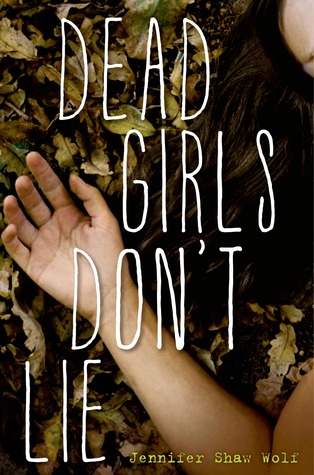
Like All the Truth That’s In Me, Dead Girls Don’t Lie deals with the darker side of human (and teen) experience. Jaycee’s summer has gone unexpectedly awry. Her best friend, Rachel, is dead–murdered. And Jaycee is torn by guilt, for not being there for Rachel the night she died (she deliberately ignored her texts to spend time with a boy at a party). But after receiving a strange video from Rachel, Jaycee starts to investigate Rachel’s death. And the more questions she asks, the more questions she finds, as Rachel’s death seems tangled up in issues of immigration, drugs, and gang violence . Jaycee isn’t sure who to trust, but if she can’t figure it out, she might be targeted by the same people who targeted Rachel.
I enjoyed this one–it was cleanly written and the tension builds nicely. If I was frustrated with Jaycee because of her insistence on keeping secrets (rather than enlisting the help she desperately needs), I also realize there might not have been as much of a story if she had sought help sooner. I also appreciated that Shaw grappled in complex and sensitive ways with issues of racial tension in a small Washington farming community, where immigrant workers are often pitted against local farmers.
3. Lindsey Leavitt, Going Vintage

If you like your fiction light, rather than dark, then Leavitt’s Going Vintage is a fun, light-hearted exploration of one young woman’s effort to reject the complications of modern technology and embrace a “simpler” time. After Mallory dumps her boyfriend for cheating on her with an online girlfriend, she decides she needs to go back to a time when things were less complicated. After finding a to-do list her grandmother made in high school, Mallory decides to swear of technology entirely (and her efforts to do so are pretty funny) and follow her grandmother’s list for herself: Run for pep club secretary, Host a fancy dinner party/soiree, Sew a dress for Homecoming, Find a steady, Do something dangerous
But in the process of following through on her new goals, Mallory discovers that a lack of technology didn’t make her grandmother’s life any simpler–nor does it make Mallory’s easier. Through the novel, Mallory makes some surprising discoveries about herself–and her grandmother.
This book does what Leavitt does best: entertains while still preserving a good deal of heart. This is light and funny, but it’s not frothy. Mallory’s growth is real and heart-warming.
4. Kasie West, The Distance Between Us

West is also a finalist in the YA speculative category for Pivot Point (her debut novel). The Distance Between Us was a delightful novel: an interesting, strong main character, a compelling love story, and strong writing. While All the Truth that’s in Me is probably better written, from a technical standpoint, this was my personal favorite. (I do like a good romance on occasion!)
Caymen Meyers is happy enough with her life: she spends most of her spare time working in the doll store her mom owns, trying to keep the business afloat. And if she regrets that she doesn’t really have a life outside the store (or a future; she’s trying to figure out how to tell her mom she won’t go to college the next year so she can stay home and help with the store), she mostly tries not to think about it.
And then she meets Xander (or Alex, as his grandmother calls him), who is exactly the kind of boy her mom has warned her about. Not a bad boy–a rich boy. His family owns an enormous chain of hotels, and his grandmother is one of their best customers. Caymen is attracted to Xander almost from the start, but she keeps pushing him away. What kind of future would they have? They’re from different worlds. Even if they dated, it could never go anywhere. But almost inspite of herself, Caymen starts to let Xander in. And the process changes both of them.
I thought both the main characters here were adorable–and I liked the secondary characters, too. The drama between Caymen and her mom felt real: they love each other, but they struggle with each other, too. And I cheered for Caymen as she figured out what she wanted on her own terms. Mostly, though, I thought this was a charming romance–exactly what I was hoping it would be.
5. Shannen Crane Camp, Chasing June

Chasing June is the sequel to Camp’s Finding June, which was a nominee for the YA general category last year, featuring June Laurie, a budding actress with a set of funny, quirky friends. This one picks up two years after the previous book, as June and her boyfriend/best friend Joseph are heading north to Utah, to start university life at Brigham Young University. There, June struggles to adjust to the new culture on campus–strange roommates, and an oddly distant Joseph who’s opted to break up with her as he prepares for his mission. Things start to pick up as June reconnects with one of her old co-stars, a non-member boy who seems to respect her values, but June struggles as the vision she had of her future starts to disintegrate.
I think a lot of young readers would enjoy this book–there’s a healthy dose of wish-fulfillment in the love-triangle between June, Joseph, and her new boy which only seems to escalate as June finds herself in talks for a plummy new movie role. But I struggled a little with the sense that despite all the hardships, things were never allowed to get *too* hard for June and I was a little disappointed at how one of the side-plots (dealing with eating disorders) was resolved. Of course, some of this is part of the genre of many YA contemporary novels: we want fun and light with just a little bit of gritty reality thrown in.
*****
On the whole, the Whitney finalists reflect trends I see in YA contemporary in general: agents and editors report an increasing interest and demand for contemporary novels (particularly with central love stories). Historical is not a hugely popular genre for YA, though I think some of the best work out there is historically based, and I think this is well-reflected here in that only one of the candidates is historical (and even then, it’s not heavily rooted in the history of a particular time and place).
Have you read any of the YA general finalist? Which were your favorites? Do you have a favorite YA novel by an LDS author that didn’t make the final list?
I've read them all except for All the Truth That's In Me, and I found myself liking Going Vintage best of the ones I've read. Thanks for the reviews, Rosalyn.
You're welcome! I think it's interesting how, beyond a certain threshold of writing, so much about reading is individual preference. I was definitely in the mood for a romance when I read The Space Between Us.
I must thank and blame you, Rosalyn, for making my already hefty to-read list a little longer.
[…] Whitney Finalists: YA General round-up (Rosalyn, Segullah) […]