

 Dr. Farina King
Farina King, a citizen of the Navajo Nation, is Assistant Professor of History and an affiliate of Cherokee and Indigenous Studies at Northeastern State University in Oklahoma. She received her PhD at Arizona State University in U.S. History. King specializes in twentieth-century Native American Studies. She is the author of The Earth Memory Compass: Diné Landscapes and Education in the Twentieth Century.
In 2019 Farina King and I met at the Mormon History Association’s post conference field trip to Church history sites in northern Utah and southern Idaho, the vast expanse where the transcontinental railroad first ran, and the area that witnessed the Bear River Massacre of Shoshone people on January 29, 1863 in Franklin Co., Idaho.
Recently, Dr. King presented on Alma 53-63 for the Dialogue Gospel Study Series. Her presentation was so spiritually enriching and culturally eye-opening that I invited her to share more of her insights with the readers and followers of Segullah.org. (You can listen to that Dialogue podcast here.)
Segullah: Thank you so much for sharing your heritage and insights with us, Farina. Please tell us a bit about your ancestral heritage.
Dr. King: Yá’át’ééh.
Shí éí Bilagáanaa nishí dóó Kinyaa’áanii báshíshchíín. Bilagáanaa dashicheii dóó Tsinaajinii dashinálí. Farina King yinishyé.
Shí éí Wááshindoondéé’ naashá. K’ad éí Tahlequahdi shighan.
K’ad éí NSUdi naashnish. Bá’ólta’í nish’í.
Shí éí Diné bizaad bíhoosh’aah.
Ákót’éego asdzá?á nish’í.
Hello.
I am English-American and born for the Towering House Clan of the Diné? (Navajo). My maternal grandfather was English-American and my paternal grandfather was of the Black-streaked Woods People Clan. My name is Farina King.
I am from Washington, D.C. I now live in Tahlequah, Oklahoma.
I am now working at Northeastern State University. I am a teacher, a history professor.
I am learning Navajo.
In this way, I am a woman.
Segullah: How did that heritage influence your career choice?
Dr. Farina King: My perspective as a professional educator and historian stems from various facets of my identity and background. I am an active member of The Church of Jesus Christ of Latter-day Saints. I am of mixed Native American heritage. My mother is English-American from Michigan, and my father is Navajo of the Towering House Clan from New Mexico. I identify as a Diné woman. Although I was raised in the Washington, D.C. metropolitan area, I have maintained ties with my Diné family. I prioritize my roles in my family and kin networks. I am a wife, mother, and many other parts in a family, especially considering Diné extended familial and clan relationships.
I knew from a young age that I enjoyed teaching. I liked to “play school” with my younger siblings. However, some of my teachers would tell my parents that I was “uninterested” in education. I have always been imaginative, and I preferred playing outside rather than learning to read, write, and solve science and math problems in a classroom.
My interest in my Diné heritage and family history drew me to academic studies, beginning in the fifth grade when my class curriculum included a unit on Native Americans. I sensed an urge to not only meet the minimum requirements but to excel in the assignments. My Diné family stories captivated me and eventually set me on a life track to become a history professor.
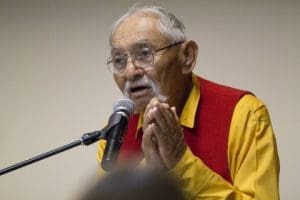 Farina King’s Uncle Albert Smith was a Navajo Code Talker in WWII.
My uncle Albert Smith shared his experiences and memories with me about his childhood, boarding school years, and service in World War II. He inspired me to learn the historian’s craft and teach history so that I could share his stories and life lessons with others. Although I entered my undergraduate studies with the determination to focus on Native American history, French Studies and West African colonial history impressed me especially after participating in a study abroad program in Senegal.
I have always loved to travel and to learn about different peoples and their cultures, since I grew up surrounded by diversity in the Washington, D.C. region. As I considered various options for graduate school, I hoped to pursue comparative historical studies of colonialism concentrating on historical experiences of Navajos and French-speaking West Africans.
In my senior year as an undergraduate student, I applied to graduate programs in Native American history and African history programs, since history departments mainly offer programs by separate geographical regions. I decided on the program for my Master’s degree in African History. I eventually came to the full realization of my personal needs to redirect my focus to Native American history. I taught as a history adjunct instructor for an academic year, while I waited for the results of my doctoral degree program applications. I decided on the program and school in which the faculty, students, and general Graduate College showed the most interest and investment in me. I continued my path to becoming a history professor specializing in Native American history at Arizona State University.
Segullah: Who were the first Latter-day Saints in your family lines? How did they come in contact with the Church of Jesus-Christ of Latter-day Saints?
Dr. Farina King: Both of my parents are converts to The Church of Jesus Christ of Latter-day Saints. My father was baptized without realizing it as a small child in an Indian boarding school. He later learned more about the Church from a family that he worked for in the summer. The family introduced him to the Church, and he later decided to attend Brigham Young University where he eventually joined the church.
My mother was a teenager when missionaries knocked on her door. Her mother, who was a single parent most of her life, listened to the missionaries’ lessons, and my mother became a member of the Church with my grandmother. My parents met at Brigham Young University after my father’s mission for the Church.
Segullah: During your recent presentation at a Dialogue Gospel Study session, I was intrigued by the overlap of Gospel principles with various emphases of Diné values. For example, can you share your thoughts on the importance of kinship and family in each?
Dr. Farina King: I learned much of my Diné identity from my father and paternal relatives. My father stressed his identity as Diné in conjunction with his Church membership. He taught me and my siblings that we are Diné by introducing us to our relatives, kinship, and ancestral homelands in Diné Bikéyah. Some Navajo Latter-day Saints like my family have relied on our heritage of tsodizin dóó sin (Navajo spirituality and ways of life) to understand ourselves and our faith. Tsodizin dóó sin centers on hózhoo – roughly translated as beauty, blessing, or harmony – a concept that explains the ways that Navajos have perceived and interacted with the world since time immemorial. Hózhoo comes from being spiritually whole and in harmony with the world and all it entails physically and spiritually. To uphold hózhoo, Navajos seek to respect nature and their fellow beings, especially K’é (kin).
Both advocates of the Church and ancestral Diné teachings respectively claim to outline pathways that lead people to happiness with a heavy emphasis on family and home. Most Latter-day Saints would explain that we exist for joy not only in this life but also in eternity, and we learn that “families can be together forever.” Diné also believe in firm ties of family through generations. Even the way that we introduce ourselves is by our family history and kinship.
Segullah: In your Dialogue session you considered chapters Alma 53-63. These are pretty blood-thirsty passages. How do you feel about all the warfare and violence found in the Book of Mormon? How can we glean spiritual meaning from those parts?
Dr. Farina King: The bloodshed, warfare, and violence of histories, stories, and realities have always been difficult and painful for me. They remind us that violence must stop with each of us. They show us how quickly humans forget and become caught in cycles of violence. As a historian, these passages of war are not that unfamiliar compared to histories and current conflicts. Our spiritual strength comes from seeking and restoring peace and following Christ through love rather than being consumed by the fear and hatred that fuel war and violence.
Segullah: Would you share some of your insights into the deep meanings of being a “warrior”? How is that something we should emulate?
Dr. Farina King: We often learn of “warriors,” and we hope to emulate and become warriors. But many people misunderstand the quality attributes of a “warrior.” In Bighorse the Warrior, Tiana Bighorse defines what a “warrior” means to Diné, which has affected how I recognize a “warrior”:
In Navajo, a warrior means someone who can get through the snowstorm when no one else can. In Navajo, a warrior is the one that doesn’t get the flu when everyone else does – the only one walking around, making a fire for the sick, giving them medicine, feeding them food, making them strong to fight the flu. In Navajo, a warrior is the one who can use words so everyone knows they are part of the same family. In Navajo, a warrior says what is in the people’s hearts. Talks about what the land means to them. Brings them together to fight for it” (xxiv).
Many people recognized my uncle Albert Smith as a warrior because he served in World War II as a Navajo Code Talker. Many people, including me, also knew Uncle Albert as a warrior in the Navajo sense. He always fought in life for the people he loved and the land. He touched many lives after his service in WWII as a teacher and parent. My Aunt Helen and Uncle Albert opened their home to many children without a place to go. They opened their home to me and re-connected me with my Diné heritage and family.
My uncle inspired me to pursue my dreams and passions, and to become a historian who could tell such incredible and touching stories as his own. He was the most spiritual person that I knew, reminding me that a Creator exists and cares for us his children. He taught me to respect all and our Mother Earth, and he showed me how the “mountain is our church.” The land orients us in our purposes and growth in life.
In my book, The Earth Memory Compass, I quote my uncle Albert Smith:
[There are disturbances in nature] . . . be careful . . . volcanoes, they might be waking up too . . . you know why it is happening. They say, some of us Americans and the rest of the world do not have any spiritual outlook. Some of them do not care about their next state. It is just one day at a time. So, those things are disturbing all the way up . . . all planets. . . . I don’t want you to be scared. I want you to think about more than just tomorrow, to look beyond that. You are still scared of the child. That is your strength. So continue, your outlook and beyond. I talk like this because many of you call me ’grandpa’ because of this one. . . . I pray for you. . . . I talk to my spiritual father.
In my book, I share how this message replays in my mind. My uncle inspired me to “look beyond the past and ‘just tomorrow.’” In a way, his words remind me of Christ’s teachings to “become as little children” (Matthew 18: 3). Remember and embrace “the child” within us—we are all children of God. Also remember the generations ahead and that we are borrowing their earth. God does not command us to deplete or destroy but to “be fruitful, and multiply, and replenish the earth” (Genesis 1: 28). To me, these scriptures and commandments align with what my uncle and elders have taught me about respecting the earth and our interconnections with all things and beings.
Segullah: You emphasize the importance of mothers – the mothers of the “Sons of Helaman” and the Stripling Warriors. How do your Diné traditions as well as your LDS upbringing enrich and inform the importance of women, mothers and their roles?
Dr. Farina King: Many Native American peoples, including Navajos, are matrilineal and emphasize strong matriarchs. Alma 56: 47-48 stands out to me because I recognize the mothers as warriors in a Diné sense of those who remind people that we “are part of the same family.” The warrior mother also teaches how to discern worthy causes to defend: “Yea, they had been taught by their mothers, that if they did not doubt, God would deliver them” (Alma 56: 47).
Navajos have traditionally given women names of warriors. As Nicolle L. Gonzales explains:
In the Navajo culture, Changing Woman is a female spiritual entity that personifies the life force of the Universe. She is responsible for the continuation of life AND is the protector of what she has created. Most traditional Navajo women have names that contain the word Baa’, meaning ‘female warrior,’ as a female warrior, she is expected to protect her family and home.
In honor of the WWII warriors such as her brother who fought for the U.S. military in Europe, my grandmother called my Aunt Florence, Nááanábaa,’ which means “She returns from war.” On May 6, 2020, Aunt Florence returned to God after a war against the corona virus. But the virus was only one struggle that my dear aunt Florence faced over her life. She was as constant and peaceful as a gentle river. She continued to flow, to give life and to give of what she could. She cared for children almost all of her life.
She cared for her grandchildren. Some of them called her “mother.” Of anyone I have ever known in my life, she was always there. She was there when you needed her. She was there, as if she was always just waiting for you. She was waiting for you to come and see her, to visit with her. She did not just talk or tell you what to do. She mostly listened. Like a rock, she was strong, still, and constant. You knew where to find her. She would be there for you. Such women help me to understand the mother warriors of Alma 56: 47-48.
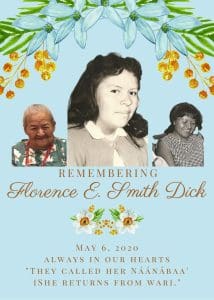 Dr. King’s Aunt Florence Dick died of COVID-19.
Although the grief and sorrow of Aunt Florence’s passing is so painful for our family, especially when we cannot run and embrace each other as we would have done before this pandemic, our hearts and spirits as family continue to connect and support each other. Florence passed on her love, tenderness, and good heart to our family, her children, and posterity. That was her greatest gift—an open heart of tender mercy and love.
She may have been very quiet and subtle, but her constancy touched many in countless ways. She shared treats like pickles and fry bread with passersby and relatives. She gathered Navajo tea to make and give away. She joked and talked with family. She used to love to sew and make quilts. She taught those around her through the food, cooking, and basic life lessons. She inspired children to become nurses, to pursue their dreams, while she was their rock and foundation. For me, her legacy and gift was her willingness to open the door to me and acknowledge me as family. If she ever wanted or asked for anything, it was for her children, her many children that she dearly loved. Generous, gracious, kind, and patient – that is how I will always remember her, our Florence.
One of her grandchildren, Alexandria Dick, said about her, “One thing that I learned from my grandma was to smile when times are hard because that is what she did. You would never catch my grandma crying. She never showed her pain as well, and she fought to her fullest.”
Florence was a warrior, Náánábaa’, who fought with kindness and a good heart for her family and love. She has returned home from the war, and we will one day reunite and embrace her again.
Segullah: What a remarkable woman she must have been!
Are there other insights can you share about reading the Book of Mormon through Diné eyes?
Dr. Farina King: I realize that my work as a public intellectual and believer in Christ’s teachings of “love one another” undergird my efforts to build coalitions and bring diverse peoples of all walks of life together in mutual respect and better understanding of our inter-connectedness, emphasizing abilities to navigate and bridge various communities.
Whatever affiliations and identities that we have, we must consider what we can do to support and encourage healing and equality whenever we are. I am trying to do that with the various communities, organizations, and institutions that I am connected to. It is a long road and journey, but every step and effort matters.
The following phrase resonates with me that describes the Stripling Warriors: “they had been taught to keep the commandments of God and to walk uprightly before him” (Alma 53: 21). To “walk uprightly” reminds me of Diné teachings to “walk in beauty.” Live a long life in beauty. Si’áh Naaghááí Bik’eh Hózhoo. This is not a superficial beauty. It is harmony and balance with all things and beings that connect with us. Living a righteous, good life restores beauty and harmony—the eternal happiness that we seek.
Segullah: Thank you so much, Farina. Please accept our deepest condolences for the recent loss of your Aunt Florence to COVID-19. Thank you for enlarging our understanding about fundamental principles of heaven and the universe, of the core commitment to hózhoo, and for your expansive view of the Gospel of Jesus Christ.
