
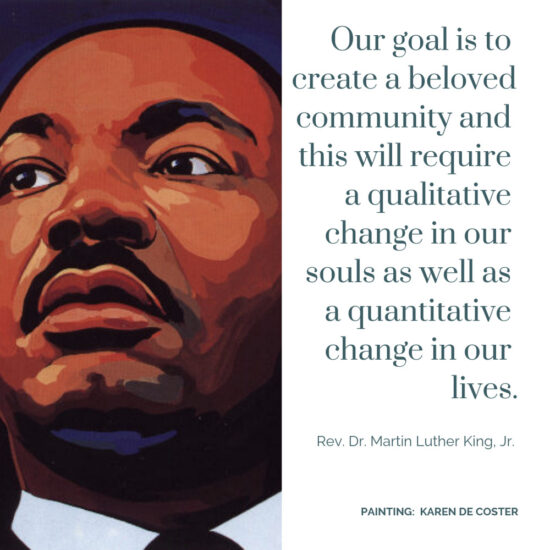
On Monday, January 17, 2022, our country will celebrate Martin Luther King Day which has been a federal holiday since 1986. One of the most potent concepts Dr. King promoted was the “Beloved Community.” As journalist Grace Tatter describes it:
Beloved community [is] a community in which everyone is cared for, absent of poverty, hunger, and hate. Rev. Martin Luther King Jr. popularized the term during his lifetime of activism and imbued it with new meaning, fueled by his faith that such a community was, in fact, possible. But he always acknowledged that realizing his vision would involve systems of law, education, infrastructure, health care, and municipal reform — no one sector, much less one person, could create it in isolation.[1]
As members of The Church of Jesus Christ, we aspire to work individually and collectively toward something similar and, possibly, identical . The term we generally use is “Zion.”
Dr. King’s plan focused on love and embraced non-violence and civil disobedience to unjust laws. There are plenty of scriptural accounts where brave souls (including Jesus himself) demonstrated these same principles[2]. During Christ’s ministry, he perplexed his followers and set the pharisees’ teeth on edge as he went about picking grain and healing on the sabbath. He was notorious for making friends with women, slaves, the poor and other social outcasts.
How did Dr. King describe the “Beloved Community”? The King Center, an organization formed by Coretta Scott King, phrases it this way:
Dr. King’s Beloved Community is a global vision in which all people can share in the wealth of the earth. In the Beloved Community, poverty, hunger and homelessness will not be tolerated because international standards of human decency will not allow it. Racism and all forms of discrimination, bigotry and prejudice will be replaced by an all-inclusive spirit of sisterhood and brotherhood.
This past September, Martin Luther King III – a lawyer, human rights advocate and the eldest son of Martin Luther King Jr. – told BYU students gathered in the Marriott Center that a beloved community is a state of heart and mind that leads “people of every race, religion and nation” to “live together in peace and harmony and work together for the common progress of humankind.”
He called for “a critical mass of active visionaries — people of all races, religions and cultural groups who not only believe that the dream of Martin Luther King Jr. is achievable, but who are also ready to work and sacrifice and suffer, if necessary, to make it a reality.”
King III said, “Those who learn how to express love in creative ways are the healers and leaders who blaze the trail forward to the beloved community.” [3]
That description puts some structure on the description of Zion Latter-day Saints glean from Moses 7:18:
“[T]he Lord called his people ZION, because they were of one heart and one mind, and dwelt in righteousness; and there was no poor among them.
In 2008, Elder D. Todd Christofferson explained:
Zion is Zion because of the character, attributes, and faithfulness of her citizens. Remember, ‘the Lord called his people Zion, because they were of one heart and one mind, and dwelt in righteousness; and there was no poor among them’ (Moses 7:18). If we would establish Zion in our homes, branches, wards, and stakes, we must rise to this standard. It will be necessary (1) to become unified in one heart and one mind; (2) to become, individually and collectively, a holy people; and (3) to care for the poor and needy with such effectiveness that we eliminate poverty among us. We cannot wait until Zion comes for these things to happen—Zion will come only as they happen.”[4]
Does LDS “Zion” make assumptions on the religious affiliation of those who participate, expecting that all will be followers of Christ? The Beloved Community Dr. King describes includes all religious affiliations. I’m comfortable allowing God to sort that out.
Meanwhile I will do as Jesus taught and as the Primary Children full-heartedly sing: “Jesus said love everyone. Treat them kindly, too.” [5]
Unlike other lyrics in that song – “if your heart is full of love, others will love you.” – I have let go of an expectation of that. I’ve been on the planet too long. It simply is the right thing to do.
I’m trying to do my part in and for the growth and health of the Beloved Community/Zion but not for any expectation that the rest of the world will be with me. Defeatist as that may sound, I release expectations for results and just live the “Way” Christ taught. I have hope that I won’t be alone on the path since, since, as Grace Tatter reminds us: “no one sector, much less one person, could create [the Blessed Community] in isolation.
Anyone with me…and Jesus…and Dr. King?

[1] https://www.gse.harvard.edu/news/19/01/achieving-kings-beloved-community
[2] https://www.craiggreenfield.com/blog/bible-civil-disobedience
[3] https://newsroom.churchofjesuschrist.org/article/martin-luther-king-iii-byu-forum-2021
[4] Elder D. Todd Christofferson of the Quorum of the Twelve Apostles, “Come to Zion,” Ensign or Liahona, Nov. 2008, 38.
[5] https://www.churchofjesuschrist.org/music/library/childrens-songbook/jesus-said-love-everyone?lang=eng
