
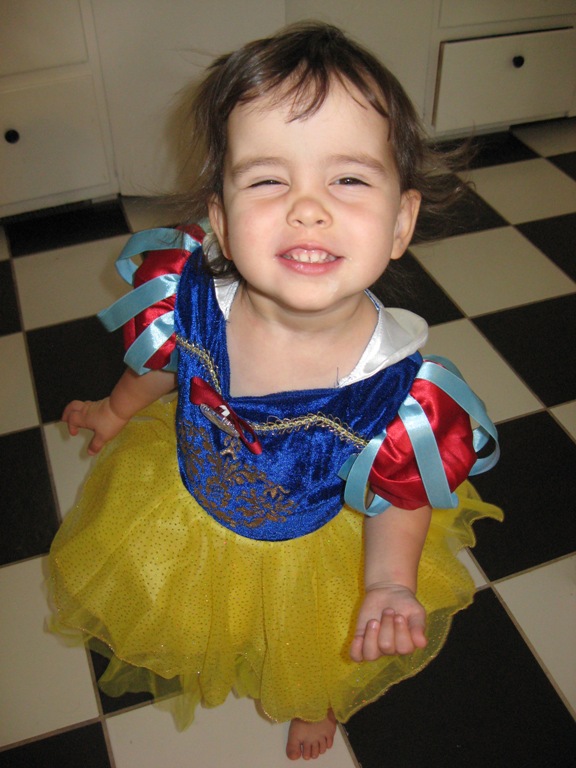
 My two-year old daughter has recently started going through the princess phase. You’re all familiar with it: the one where she wants to wear princess clothes (or anything close to it) all the time–not just for half an hour during dress-ups, but all day, out in public, to meals and even to bed.
Usually I let her (unless I have a compelling reason to say no). After all, I’m the one who bought her some of those dresses in the first place, and she’s at that stage where, dark-eyed and dimply as she is, she looks cute in just about anything. (In a few years, of course, fear of public criticism might make me change my tactics—but for now, most strangers just smile when they see her).
But sometimes, if I’m honest with myself, I have to admit to mixed feelings about the whole thing. And I’m not talking about the hassle of washing those hand-wash only dresses (ours go in the washing machine anyway). I’m talking about the social narratives that go along with “being a princess.”
Our culture (driven in large part by Disney’s multi-billion dollar enterprise) has done a lot to craft the idea of a princess as someone who lives an incredible life of wish-fulfillment, someone whose troubles are magically swept away by the entrance onto the scene of a fairy godmother or a handsome prince. To give Disney some credit, their more recent heroines have been increasingly independent and hardworking—Tiana, from the Princess and the Frog, is my daughter’s current favorite. But I’m not sure that my daughter looks at this character, as I do, and admires the blend of hard-work, ambition, and concern for family that motivates Tiana. I think she mostly sees the sparkly dresses.
My main concern is: what happens when we let our children buy into this social narrative of princesses? Do we do our daughters (and sons, who often get cast as the heroes meant to “rescue” the damsels in distress) a disservice when we disseminate the same princess myths without taking time to interrogate them?
It’s not that I don’t hope for a happy ending for my daughter (a temple marriage to a good man, a virtuous life). But the rich, spiritually fulfilling life that we all aim for in the church means far more than the thin happily-ever-after of a fairy tale. It’s impossible to reach our ultimate destination (life with God) without considerable effort—we don’t become Christ-like by skimming across the surface of life, by skipping past the kinds of wrenching trials that purify us. As Milton once wrote in Areopagitica: “I cannot praise a fugitive and cloistered virtue, unexercised and unbreathed, that never sallies out and sees her adversary but slinks out of the race, where that immortal garland is to be run for, not without dust and heat.” Where there is no real challenge, there is no real virtue. A friend of mine once confessed that she didn’t really enjoy it when her daughters got into the princess thing–in her view, her daughters were already living the rich life of a princess: being waited on nearly hand and foot by parents who provided them with every material need.
I’m not saying this to condemn those (parents and children alike) who enjoy princess stories or who like dressing up in sparkly dresses. In the interests of full disclosure, I admit I remember spending much of my childhood as a princess. I was a princess for Halloween every year until I out-grew trick-or-treating. When I was in junior high, I was part of a medieval feast re-enactment, and when I was chosen to be Queen for a night, I felt (if briefly) that I’d reached some sort of summation of my dreams–I’d always wanted to be a princess. (The power of this cultural mythos is pretty powerful: I still feel it. Some days, I *do* want to be a princess, to wear beautiful gowns and pretend that everything is well in my world.) I think we do get genuine pleasure out of princess narratives. It’s just that there’s much more to life than these stories can possibly convey.
For now, my daughter’s enjoyment in her princess clothes is still pretty innocent: she likes the sparkly fabrics, she feels pretty, and she likes identifying with characters she recognizes. And I get a distinct buzz out of her patent pleasure. What I hope, simply put, is that as she grows older I can help her see past the glamour of the happily-ever-after to a deeper truth about happy endings: that being happy in this life does not come through the things we own (however many sparkly dresses that may include) or through the things that happen to us. Being happy comes from who we are—from the strength of our relationship with our God and our Savior, from our family relationships, and from the character we forge through our trials.
What about you? What are your thoughts on the “princess phenomenon”? Do you love it? Hate it? Why?
And for those of you whose daughters (and sons) are older: what tricks have you found for teaching your children about real, lasting happiness? How do you help your children see past the joy that many of them find in the more innocent of worldly pleasures to the gospel ideal of joy?
Awww…she's so cute. My grand-daughter was into princess everything from about that age on to about what she is now which is seven. Other interests start happening. But while they love the fantasies, it's so cute and their imaginations get quite a workout. I love to watch their little brains work.
I have three daughters that have grown up and through this princess phase, and they have all successfully breached the illusions of the phenomenon, I think. Some of them embraced the sparkles more than others, but they've always had to work hard around our house, and they've always known and watched their dad behave like a true prince should – not in a big, manly, lording way, but as a loving protectorate of an already capable brood.
In some ways, I don't think men should feel that they have no right to rescue, but women should also feel that same strength of character. I have no desire to emasculate by husband or his natural tendency to want to protect me or my girls, but there is so much strength in teaching my girls to be strong in their own right.
And at least at our house, the princess phase didn't teach them out of being strong and capable and talented.
Around our house, happiness is a choice, sometimes a hard fought choice, sometimes an easy luxury. But our happily-ever-after is one of our own choosing, and I don't want my girls to grow up feeling that life has no joy and no hope, so I'll keep telling them to dream big – right after they scrub the toilet.
When I was YW president we used the "Princess" theme. We all are princesses – Daughters of THE King. Our For The Strength of Youth booklets were our "Princess Handbooks," teaching us how to return to live with the King. We are all children of God, but to be a princess – a daughter of the King, we have to choose to follow Him. As women we all want to be a princess, and why not? In fact, I don't have a problem with the Disney princesses, for the most part they are admirable characters with a devotion to truth, serving others, and being kind. We need them to dress a little more modestly, though!
I have 4 sisters, no brothers, so my home of origin was a pretty estrogen rich, princess friendly environment. When I was young, my mom cross stitched a poem for my bedroom wall: "I am a child of royal birth, my Father is King of heaven and earth. My spirit was born in the courts on high. A child beloved, a princess am I." Our young women have also used the celestial princess theme before and I long ago took the cross stitch for my daughter's room. I think princess lore doesn't have to descend into damsel in distress lore and there is something empowering about realizing the divine royalty within all of us.
I also think trying to keep our daughters from their princess phase is futile. I even met a woman on a plane once who had never exposed her daughter to TV, movies, Disney of any kind, no princesses or barbie of any kind and still, when she turned 3, all she wanted to be was a princess. The mother was aghast and couldn't imagine how something like this had happened. I'm guessing the little girl heard the terminology from friends and ran with it. I just laughed.
Princess seems pretty hardwired in little girl DNA, but turning that love of pink sparkly, magic and royalty into the need for a rescue is learned helplessness that is NOT hardwired and also not terminally embedded in princess lore. And besides, who doesn't love a twirly dress now and then?
I read an article in BYU Magazine about SAHMs who use their education to enrich the lives of their families. One mom was an art-history major at BYU, and when her daughter went through the princess phase, she took down her books and showed her daughters pictures of real-life princesses and took the opportunity to teach her daughter about both art and history. I really like that approach. To give our daughters only the idea of Disney princesses might be doing them a disservice, but to teach them about art, history and politics would not be. In simple terms, of course, when they are young, but they can learn at any age. Let them have their sparkly dresses, but let them learn beyond that too.
I appreciate the comments so far!
@Lucy–I agree that it is fun to see children's imaginations at work. My daughter frequently makes me laugh (she likes to reenact the part where Tiana gets turned into a frog). But I also get a thrill out of seeing her enact story lines that aren't about princesses.
@Justine. Thanks for the reminder that strength and capability aren't incompatible with femininity (e.g. being a princess). And I loved your last line–it made me laugh.
@Janet and Angie. What you say about being daughters of God is actually part of my point–we *do* have a divine heritage. But being this kind of "princess" involves much more depth, strength, and richness than what society's princess narratives often allow for.
@Katie. I remember that article! (As it turns out, the mom in question, Taliatha Holmes, is a friend of mine from BYU days). And certainly, making my daughter aware of the historical realities of the life of a princess would go a long way towards combating the idea that the life of a princess was always romantic (most princesses married for strategy, not love). Thanks for the reminder.
I'm not a big fan of the whole princess thing, although it's not an issue at my house because I only have boys. I did grow up in a family of five girls, but we still weren't much into princesses. They certainly weren't forbidden, but none of us cared much about them. The same goes for my nieces. I don't have any specific problem with princesses, but I think there are more worthwhile ways to teach children the positive values you can learn from princesses. How about teaching our girls more about women from the scriptures and Ardis' women from church history? And about the strong girl characters in so many books now?
I'd be uncomfortable with a YW activity that was about princesses, just like I wouldn't be excited for my boys to go to a Scout or YM activity about superheroes. Of course, that wouldn't happen. No one would dream of a superhero theme for my boys' scout den or troop.
I believe that where a parent could fail is if they teach a child only about princesses and happily ever after. Just as they would fail if the child were only taught to work or only taught to play. We are counseled to have moderation in all things. Hard work should be followed by recreation and relaxation. In the same sense, there is no fault in a girl dreaming princesses and all things glittery if those dreams and fantasies are accompanied with lessons of strength and valor.
Another place we fail is reading too much into our daughters love for princesses. We, as adults, dissect these characters and assume that our daughters are doing the same. But really, are they? Just like you said, I don't believe they are looking much past the sparkles and is there really any wrong in that?
I say let them be little. Let them dream. Let them sparkle. All too soon the reality of the world will hit their sweet innocent spirits and we will long for the days of princess dresses and play-dates.
Elder Uchtdorf gave a fantastic talk recently about happily ever afters. His premise was that between the dream and the happily ever after there needs to be strong character and hard work. I loved that. We did a happily ever after themed activity for our YW too, because of that talk.
I'm not too worried about the princess phenomenon. I hope my boys (I hope to have some someday) will treat the girls and women in their lives like princesses. I hope my girls try to change the world with their love and their talents.
Society's views on things like princesses don't bother me. I'm the mother, and when my little girl is in my home I teach her what I believe and what is important to me. She's a princess to me, and she knows it. That means something in our home that it doesn't mean outside of it. That's okay with me.
I've always been uncomfortable with the princess thing for many of the same things and have really tried to downplay it with my daughter. As far as the specific "Disney Princes" marketing we've mostly avoided that by having a family movie night where we watch movies once a week, with a different movie each time. So she has seen most of the princess movies a few times but not on repeat over and over. I understand that turning things into 'forbidden fruit' can just make them more appealing, so we just try to downplay attaching yourself to any one thing and instead enjoy a variety of interests–dinosaurs, trains, Batman, princesses, Barbie, ponies, etc. We have toys and dress-ups from a variety of genres for the kids (my daughter is 7 and my son is 4). The latest obsession around here is Scooby-Doo, which I think is completely inane, but at least it's usually pretty clean.
If it were up to me I would keep my children cloistered away from all popular culture forever 🙂 Thankfully my husband provides balance since he is totally obsessed with comic books. He buys comics for the kids and I think there are some good role models there (kind of–depends on how you look at it). Amira–I'm also equally uncomfortable with either princess or superhero themes for youth activities, but I could possibly see ways you could make it work.
And I have to brag a little about my husband–he actually has an essay about raising a daughter in the most recent issue of Sunstone (it's called "Raising Wonder Woman in Man's World" 🙂 )
Let them love princesses. It is such a short time in life that we get to think everything is lovely and wonderful and filled with princess, unicorns, and rainbows. Just because it isn't real doesn't mean we can't enjoy it. Besides, this princess loving kids are more savvy than we give them credit for.
Now, an older girl or a woman with a princess syndrome is an entirely different thing. Nobody wants that. I think the best way to prevent it is to talk to your kids, honestly, often, and age appropriately, about relationships, responsibility to self, what makes our own lives happy, reasonable expectations, etc. Bottom line, they are smart enough to learn the difference between fantasy and reality. We just need to take the time to teach them.
I don't know, in this world it is so hard to maintain self esteem and confidence in girls. If they can hold onto the fact that they are valuable, and indeed, princesses of a Heavenly King, then more power to them. Just make sure you give them some chores to go along with their Cinderella complex. lol
My girls weren't big into princesses. One of them DID dress up a lot but it wasn't just about being a princess. It was about dressing up. She generally did it with friends and they played elaborate pretend games which sometimes, but not always included princesses. Sometimes there were fairies, villians, moms, servants, teachers, etc.
Do you call them princess dresses? Do you only give her princess dresses that look like Disney characters? If so, expand it a little.
Dress up can include ballerina stuff. It can include the "pink dress" and the "red dress." Include accessories and things for her to "do."
A magic wand can make pretend play go farther than just "being a princess." She can DO something.
She doesn't have to do something amazing like cure cancer. Just whatever sounds fun to her. She can change the colors of the things around her. She can turn family members into animals and they act like the animals, etc.
Also, when she is dressed up she can still read books, draw, sing, etc.
So, I would just say that you can expand the princess dress up play into positive, developmental cognitive play that is age appropriate.
As women we all want to be a princess, and why not?
Janet, that's not only a false generalization, but a potentially dangerous one. And I believe a princess-themed YW event, while well-intentioned, is similarly misguided.
I'm all for a 3-year-old dressing up as Snow White if that's what she loves. (I'm all for a 3-year-old dressing up as just about anything.) That's very different than holding a church-sponsored activity for girls that types them all as princesses (or as ANYTHING, for that matter, but especially something from the realm of fairy tales). It would be bad enough to sell that image to Primary-age girls. For YW it's even worse.
Chieko Okazaki wrote about one such YW event. It had a Wizard of Oz theme, with the Temple representing the Emerald City. The program so troubled the attending stake president that when he was invited to make his remarks at the conclusion, he said this:
Girls, this has been a beautiful program. I commend the gospel with all its auxiliaries and the temple to you, but I do not want you to believe for one minute that if you keep all the commandments and live as close to the Lord as you can and do everything right and fight off the entire priests quorum one by one and wait chastely for your missionary to return and pay your tithing and attend your meetings, accept calls from the bishop, and have a temple marriage, I do not want you to believe that bad things will not happen to you. And when they do, I do not want you to say that God was not true. Or, to say, "They promised me in Primary, they promised me when I was a Mia Maid, they promised me from the pulpit that if I were very, very good, I would be blessed. But the boy I want doesn't know I exist, or the missionary I've waited for and kept chaste for so we both could go to the temple turned out to be a flake," or far worse things than any of the above. Sad things–children who are sick or developmentally handicapped, husbands who are not faithful, illnesses that can cripple, or violence, betrayals, hurts, deaths, losses–when those things happen, do not say, God is not keeping his promises to me.
He then went on to say:
The gospel of Jesus Christ is not insurance against pain. It is resource in event of pain, and when that pain comes, rejoice that you have resource to deal with your pain.
I know this princess program for YW is trying to emphasize our divine nature as daughters of God. But even if the FTSOY booklet, diligently followed, eventually lands you a canopied bed in the celestial kingdom (which is debatable at best), a glittery paradigm of protection and privilege does nothing to prepare YW for the realities of mortal life. And that's preparation that every single one of them dearly need.
Kathryn, thank you for your comment! You articulated the issue beautifully: the problem is not with the stories in and of themselves, but in holding up the stories as the primary model for how our girls should see themselves (and not helping them to see beyond that model). I love the final quote you give from that stake president: that the gospel is not insurance against pain, but it provides a resource for dealing with pain. Allowing our children to see life as a fairy-tale (in whatever form) doesn't, as you say, equip them with the resources they need to negotiate life.
Other comments suggest that it's about finding balance: I like FoxyJ's suggestion that we expose our children to multiple kinds of narratives (with their multiple ways of viewing the world), children are less likely to view themselves as bound to anyone narrative. And of course, age appropriateness is a big consideration: my two-year-old wouldn't be able to follow the kinds of considerations that this topic involves; but I would hope that by the time she's twelve she can understand most of them.
I think there's a big difference between princess as fairy tale in a canopied bed and princess as a symbol of divine nature. I don't think the princess symbol is universally flawed. I agree with Olive that it can be difficult to maintain feelings of self worth in this world for young and adult women alike. Of course when we tie this princess image to the emerald city and happily ever after we are selling (or buying as the case may be) a false bill of goods. But if we instead tie the princess idea to more of a "where much is given much is required" concept I think we are better arming them (and ourselves) to deal with real life. Real life is gut wrenching, no doubt, but to me, reality taught with the empowerment of divine nature is better preparation to weather the trials and difficulties of real life–a way of giving depth to the gospel resources we are trying to teach. No, obedience to divine laws affords no inoculation against pain and heartache, but it is the only path to eternal happiness. Perhaps we sometimes err in attempting to visualize eternal happiness in temporal terms and end up with this image of an Emerald City in the here and now or a happily ever after at the temple. To me that doesn't mean the image is flawed, but that the timetable we attach to that image is.
I know plenty of women who have bought into the false ideal that they are entitled to pampering and happily ever after and when the first isn't possible and the second doesn't come, they wail about in a "woe is me" mess of testimony destruction and self-pitiful behavior. But I also know plenty of women who cannot see the princess, the divine, within themselves and as a result see no reason how the gospel can be true for them or why God (or anyone else) would even, could even, love them, let alone how a plan of happiness could be more than the cruelest of fairy tales. The first group of women is annoying and regrettable, but the second group of women is far more troubling to me. Maybe that's why my favorite princess stories include the Paper Bag Princess (Munsch) Fannie's Dream (Buehner) and CinderEdna (Jackson).
Angie–you raise a good reminder about the need to help girls (and grown women) recognize that they do have potential–but I think the "where much is given, much is required" idea is one that grows out of more historically grounded princesses, rather than the typical fairy-tale princess. (Incidentally, we're also big fans of the Paper Bag Princess and CinderEdna at our house. There's just something so satisfying about a Cinderella figure who puts her dress on lay-away.)
Yes, teaching divine nature is of vital importance. But please, let's not use "princess" as shorthand for "daughter of God."
Thank you for your comment KLS, and that quote from Sister Okazaki. Growing up, I always assumed that there were problems in my family because we weren't keeping the commandments closely enough. I vowed to remedy that when I had children by being dillegently obedient. But guess what? Things have still been really, really hard for my husband and me. I don't mean to minamize the blessings that come from obedience, because they are real–even if sometimes only seen with an eye of faith.
But, my adult life has been unlike any fairy tale. I appreciate Sister Beck's words in the last General Relief Society Meeting,
"In the growing climate of entitlement, excuse, apathy, and enticement, daughters of God who are not watchful, prayerful, and inspired are increasingly at risk of becoming what the scriptures describe as 'silly women' who worship a variety of 'strange gods.' Sadly, as a result of life’s difficulties and the world’s popular heresies, many sisters believe the myths more than the truth. Their misalignment with God’s plan is demonstrated in findings that many are not doing essential things such as praying and reading scriptures. The Lord Himself has said that 'this is a day of warning, and not a day of many words.'
Have you watched Disney's Snow White or Sleeping Beauty lately? Those are "silly women". Not images I want my daughter emulating. There is no escape from the hard work of motherhood and living the gospel amist opposition. There is much joy in these things too, but as a YW leader I try to teach the girls to prepare to WORK HARD. They will have to sacrifice to bless their homes, husbands, and families
.
Kathryn, your comment was wonderful! I think it's great that little kids can dress up to be anything they want–and Rosalyn, your daughter is adorable. So I think that's all fine and dandy and really cute. My problem (and not with your daughter's dress-ups) is that I have a lot of friends (I'm a twenty-something in college) who haven't grown out of the princess phase. It's embarrassing to admit, but for me, it actually was a HUGE wake up call when I did have to realize that marriage isn't a cure-all for everything. I feel like I was given the false impression (not only in primary and young women's but by the Disney enterprise and Western entertainment industries etc. etc. etc.) that marriage = happiness. It's been really, really weird as I've grown up and had more friends get married to realize that marriage doesn't solve all your problems. It should be obvious, I know–and that's why it scares me so much that it took me a LOT of living to figure that, and that a lot of my friends still haven't reached that point yet. It's scary, and it's really, really dangerous. Anyway, it was really nice to read what that stake president had to say; I feel like primary and young women's tried really hard to teach me basic gospel principles, but they somehow never conveyed the crucial idea that things don't always work out for us all the time. You just have to read the scriptures to see that it's there–the Lamanites separate from the Nephites, for example, in spite of all of Nephi's heartache and pain and love for his brothers. His life is full of hardship and struggles–and I feel like that's something I never understood because I've always seen Nephi as this superhero figure.
Anyway, I guess I'm just dealing with the realities of life for the first time, which is a good thing, and I'm glad the scriptures convey such an accurate sense of reality: things are hard, and therefore all we need to do and all we can do is rely on Christ. So in conclusion, I wish the princess thing could get knocked from young women's (and where I am right now–BYU culture) to be replaced with things that actually convey real life experience. I wish we could talk about those things accurately and wholly, and I wish we could see Disney princesses as what they are–fun, and good for kids in certain ways, but not as actual portrayals of real life experiences, especially not of dating or marriage.
Kyliemm, you are a beautiful, smart, articulate girl and your mother loves you. 🙂
I find this post especially interesting in light of the fact that just last month our stake YW standards night was centered on a princess theme. The night was supposed to be focused on President Uchtdorf's "Your Happily Ever After" talk, with an emphasis on the girls' divine worth and the goal of marrying in the temple. First of all, I want to clarify that I strongly believe we need to teach our girls their divine worth, and that we should center our YW lessons on helping our girls prepare themselves to make covenants in the temple. I also love, respect, and admire the women in our stake YW presidency and consider them to be my friends, and I know they pray over our girls and take their stewardship seriously, so I don't want to come across as sounding critical.
That being said, I must admit I was uncomfortable that night. All of the young women and leaders were asked to come dressed up as princesses. Yes, the leaders as well. And most of them did. My daughter, who is 12, was a little uncomfortable even at her age dressing up like a princess (she's outgrown it), yet there were grown women—some as old as 60—decked out in long pink gowns and tiaras.
Kathy hit the nail on the head: "A glittery paradigm of protection and privilege does nothing to prepare YW for the realities of mortal life. And that’s preparation that every single one of them dearly need." I know that we want to be encouraging and positive as we teach our youth and help them reach the goal of going to the temple, but I think we set them up for disappointment, and worse, crises of faith, when we sugarcoat or ignore some of the realities of life our girls will face, despite having done everything right and marrying in the temple. We need to help them root their faith deeply in the gospel and understand who they really are (not a Disney princess!), so that they can bind themselves to God and become strong, faithful, capable, and righteous women who can handle life's challenges. A tiara has nothing to do with that, and it does our girls a disservice to imply that it does.
Sometimes I think the role playing that children do is an attempt to figure out who they are, find out what they are comfortable with. I certainly never encouraged the whole princess phase, but I'm not putting it down either. My kids aren't showered with presents at Christmas (they get one, maybe two), they aren't in all the extra curricular stuff their classmates are in, they know that my answer to "Can I have that?" is usually going to be, "no." They know life is hard and that there is no fairy godmother or genie that grants wishes. For the time they fit in the costumes in the dressup box, I'll let them go through whatever phase because I know that pretty soon the outfits won't fit anymore – if they ever did.
I've thought about this too. Especially when my daughter asks me to read the Princess book about choosing just the right dress. Oh, that one gets under my skin.
There are good and bad aspects to the Princess ideal. I guess it's my job as her mom to reinforce the good ones.
I've made a conscious and decided effort to steer clear of princesses at our house. I really bristle at the suffocating marketing of the princess image that bombards little girls today. The image is so prominent and inescapable, I just don't want it monopolizing the imaginative play of my 3 year old daughter.
The other issue I have is that the concept of "princess" seems linked with an attitude of entitlement and being catered to. Yes, my daughter is a daughter of God, but if anything, this title only places greater responsibility on her shoulders. It does not mean everything should easily fall into place for a Disney-like happily ever after.
I don't mind her playing pretend, and sometimes she does play "prince-a" with a costume of her own making. Somehow she still knows the names of many of the Disney princesses. She even went to a princess party and donned a tiara like all the other girls.
But with all the other things in the world to be interested in, I just don't see the need to buy into the marketing and encourage the "princessization" of my daughter.
Especially when she really loves Curious George.
@Kylie and CMB: you both raise some of my own concerns (and things that I've witnessed in my own friends, particularly some of the single ones who persist in believing they will be happy when they finally get married). To borrow from a much-beloved movie at our house: "Life *is* pain, highness: anyone who says differently is selling something." I genuinely believe that God wants us to be happy–joyful even–but that joy often comes as we work through our trials (not s we rake in entitlements). I remember having an epiphany a few months before I started dating my husband (I was in my mid-twenties at the time): I realized that if I couldn't be happy in my own right, I wasn't going to be happy just because I was married.
@mormonhermitmom–I agree: I think part of the appeal of dressing up for children is the chance to enact different roles. Our dress-up box at home is proof of this: we have animals, super-heros, dinosaurs, knights, and (yes) princesses. And both my daughter and my son have worn most of the costumes. But while I think the creative play is empowering to children, I still think that they need our help to look critically at different narratives (particularly in looking at these stories through a gospel perspective), so that when they craft their own role in life, they are doing so with eyes wide open.
One more thought since my last comment: I was in the temple today, and after I read your post, Rosalyn, I thought about how unsuitable and shallow a princess costume seems in comparison to the clothing we actually wear in the temple as we participate in sacred ordinances. I wish we contemplated the significance of that contrast more in conjunction with teaching our young women. Then, perhaps, we could better prepare them for the temple and life's experiences–and also give them a better glimpse of their potential.
And I'm not against little girls dressing up as princesses, btw, as part of creative play. My own daughters had their share of Disney princess costumes. But I am uncomfortable with princess costumes being used as a teaching tool in Young Women.
Great post, Rosalyn!
I've been thinking along the same lines, Melissa. The connotation of "princess" is oh so different from "queen and priestess."
Historically, too, princesses were typically much more circumscribed than queens. Think, for example, of Queen Elizabeth or Victoria–before they became queen, both held very limited power and were seen primarily as political pawns. They didn't come into their own until after they shed their title of "princess." I wonder if that's part of what's disturbing in princess narratives–the very nature of being a princess generally means that you are still a minor in some capacity; you are still dependent upon others. That is to say, a grown woman who still looks to "princesses" for inspiration is a woman who has yet to come into her own as an independent, powerful woman.
I think the original fairy tales from which these "princesses" come have great value in our children's lives. The original fairy tales are magical and archetypal, very symbolic. I want my young daughter (and sons as well) to grow up hearing these tales, they are part of a rich story-telling tradition with which I hope to surround my kids.
To me, the real issue is Disney. You cannot think of Cinderella or Snow White without thinking of the Disney versions of those stories. It makes me insane! Disney is responsible for this whole princess phenomena, and that is what I rail against. I will not buy my daughter ANYTHING with a Disney princess on it. She has seen a couple of the movies (at other people's houses), but I am trying hard to keep the rest from her until she is old enough to at least hear the original stories first. I want her to hear those stories in their unadulterated forms.
I don't mind if my daughter dresses up like a princess, in fact I made her a princess castle cake last year for her birthday. I also made her several felt princess crowns and a medieval princess gown for Halloween. But NO Disney princesses! Period! It's partly about the marketing–it sickens me the money they are making off of these princesses. It's partly because I believe the Disney movies have shifted the focus of the original fairy tales. The movies make it all about romance, when the original tales are about far more than that.
The only "princess" book we own is a sweet little book called The Princess in the Forest. In this book, the princess spends her days playing with the animals and forest folk. There are no princes and no romance anywhere in it.
It's interesting to see what gets under different women's skin with the whole princess thing.
Here's what I have done to try to keep my girls grounded.
– Be cheap. I've had countless conversations about why we aren't buying that shirt or this costume or whatever. If we don't get sucked into the marketing games, we avoid a lot right there.
-Don't let it translate into an obsession with looks and fashion (and be examples of how not to get sucked into that). To me, if there is a princess problem, I think it's almost more problematic in the subtle ways the messages come through nearly almost everything girly. We also have the modern-day "princesses" taking over labels, like Miley Cirus etc., (really don't get me started). Please, could I just buy a shirt that isn't taken over by glitter, glitz, glam, and gleaming teeth of teen stars? (PLEASE?) At least cartoons can ultimately be processed as pretend.
-I think the most important is to teach doctrine clearly, plainly, and repeatedly (which to me is most important). I love this from Pres. Packer: "True doctrine, understood, changes behavior quicker than talking about behavior changes behavior." We can start before they can talk and keep it up until after they leave our homes, looking for those fleeting moments to teach them all that isn't there in fairy tale or Disney land. Doctrine is power.
One more thing we are doing — we try to be deliberate about reinforcing and building friendships with families who care about similar things we do. If I can have conversations about real concerns with a mom, I'll be more apt to encourage play dates, etc.
I've been surprised at how important this has ended up being to me, and surprised at how some young friends really have had a significant effect on my girls. I figure if they can have as many experiences with good friends before they are teens, all the more chance their brains can develop with some substantial understanding and connections before hormones kick in and I have less direct influence where friendships are concerned.
Whenever I go to the temple, especially when I'm sitting in the Celestial Room w/ my hubby, I feel so like a princess. Or a queen. I feel royal, and I think that is what the little girl in all of us women wants/needs to be reminded of–that we are daughters of a Heavenly King, w/ divine, royal destinies, as future heirs of salvation. The childish dress-up may well be our spirits' remembering our true identities.
'Course, on a lighter tone, one of my daughters is very much a tom boy, and spent 9 months, day and night, dressed up in a Spider Man costume (the kind w/ muscles), when she was 2 years old. She outgrew it, eventually, but still scorns most things frilly. My 4-year-old is a princess now. It's all about the pink and the sparkly.
I love the princess phase we are in right now–it consists if my five-year old running around the house with a bunch of Lysol wipes and saying "What do I wipe now, Step-mother?"
It also dovetails nicely with the Annie phase where she cleans and cleans and begs me to lock her in the closet.
The stake president Okazaki refers to is Carl Broderick who wrote about all this in a women's conference talk entitled "The Uses of Adversity." It's a simply fabulous talk in its entirety.
You can read it here:
rusch.files.wordpress.com/2006/09/the-uses-of-adversity.pdf
Read Valerie Hudson's fabulous take on fairy tails and LDS women here:
http://squaretwo.org/Sq2ArticleHudsonEnchanted.html
@eljee mentioned the book Princess in the Forrest as one she likes for its depiction of a princess.
I can also recommend The Paper Bag Princess by Robert N. Munsch. It starts out typically (princess to marry a prince) but she overcomes adversity and decides she doesn't want to marry the shallow prince who only cares about the way she dresses. I think alternate princess stories like this one can also help our daughters think about the stereotypes and who *they* want to be.
I have one smart mama <3
And I ADORE The Paper Bag Princess! Every small child should read it 🙂
@Deborah,thanks for the link–I particularly liked the part where the author points out that we're not faced with just two alternatives: a fairy-tale "happily ever after" or resignation to the grim reality. We can choose to face reality and make our own happiness within it.
@Michelle–I love your reminder that the best way to complicate worldly narratives is with grounding in doctrine. I agree.
As a college student who wasn't in YW that long ago, I want to share my opinion.
I didn't feel like the princess thing has affected me or spoiled me that much. Growing up, I realized that Disney is a fantasy and not a reality. My role models changed from movie characters and celebrities to the stalwart latter-day women who showed me how to live the Gospel and exemplified Christ. In watching them and being taught by them, I learned that bad things happen to good people, that marriage does not solve every problem, but that the hope of the Gospel is that we can find peace and happiness in every trial as long as we stay close to the Lord.
So here's my advice- don't spoil your daughters. Teach them to work and admire the right people. Teach them how the Gospel helps us overcome trials and find a REAL happily ever after.
And don't worry too much. Most of us young adults have grown out of the Princess phase :]
My 5-year-old likes to pretend she's a princess, she just doesn't like her princess dresses to be too sparkly. She also likes to pretend to be a cat and Darth Vader. So I'm not too worried.
I'm extremely uncomfortable with the whole phenomenon. I only have boys so this has not been an issue at our house. I find the Disney Princesses and everything they stand for (infantilization, helplessness, over-emphasis on physical manifestations, consumer culture, manipulation of young minds, waiting for a "Prince",) repulsive.
(Unless they really do beg to clean the house, in which case I might turn around right fast.)
Kathryn, this is the second time I have felt attacked by you over a comment I have made. I guess we just disagree.
To be honest, while I don't care for all the marketing hype of the Disney princesses, I recently took my grandchildren to see the princesses in Disneyland. I teared up watching the princesses interact with the children. They were the perfect example of one-on-one Christlike loving attention.
This past summer our ward YW camp theme was: Princess Warriors wearing the Whole Armor of God. The YW learned about the armor of God and how to use it in their lives to combat evil, the fact that they were wearing pink at the time just makes it fun. (And our YCLs chose the theme and scripture)
When I was called to be YW president I went to the temple and studied the scriptures and felt prompted to use a "princess" theme. I do not think there is anything wrong with teaching gospel principles and making it fun at the same time. It is a true principle that while we are all a "child of God," to become the "children of Christ," we must choose Him and follow His gospel. We choose to be a Daughter or The King. We never taught that being a princess means that you will be waited on or not have struggles in your life. President Uctdorf's talk was perfect in showing that all princesses have challenges to overcome before "happily ever after" happens.
Frankly, a princess is a girl preparing to become a queen and priestess.
I really like how Amy (#32) put it:
'Whenever I go to the temple, especially when I’m sitting in the Celestial Room w/ my hubby, I feel so like a princess. Or a queen. I feel royal, and I think that is what the little girl in all of us women wants/needs to be reminded of–that we are daughters of a Heavenly King, w/ divine, royal destinies, as future heirs of salvation. The childish dress-up may well be our spirits’ remembering our true identities."
To add to the other suggestions of alternate "Princess" stories, I also recommend the Cinderella story as it appears in G. Rossini's Italian opera "La Cenerentola." It's one of my favs. Cinderella still has two mean step-sisters (along with a step-father), gets to go to the ball in a beautiful, sparkly dress and marries a prince at the end, but it's all due to her kind and generous acts towards others. At the end, her "revenge" against her step-sisters and -father is to extend them love and forgiveness.
And did I mention that the music is gorgeous? If you ever have the chance to see a production, take your kids.
[…] timely post, this mother wonders if she should teach her daughter to go “beyond Dress Ups” in wanting to emulating princesses. she […]