

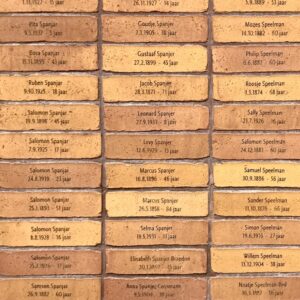
On a recent trip to Amsterdam I signed up for a tour to visit the Holocaust Names Memorial. Dedicated on 19 September 2021, 76 years after World War II, the monument displays walls of bricks with the names of more than 102,000 Dutch victims of the Holocaust.
Each brick is a testament to an individual, listing their name and their age at the time of their death. This is a place where the 102,000 Jewish victims can be commemorated individually and collectively. The names that seemingly go on and on carry psychological weight exponentially larger than their actual numbers.
We live now in a world both of atrocities, and of monuments to them. I have seen memorials with names listed. Our own country’s Vietnam War Memorial moved me to tears of grief when I first saw it years ago in DC. I have noticed the “Stolperstein” in Dutch and German streets – literal stumbling blocks commemorating the lives of Jews killed in the holocaust. There is something about the names – one after another, after another.
On my tour, sunshine dappled through leafy spring trees. The cacophony of traffic and nearby children surrounded me in the handsome city neighborhood. I followed my tour guide to the site.

As the memorial’s website explains:
The memorial consists of four Hebrew letters that make up a word that translates as ‘In memory of’. When visitors enter the memorial, they find themselves in a labyrinth of passageways flanked by two-metre-tall brick walls that convey the message ‘In memory of’. Inscribed on each of the 102,000 bricks is a name, date of birth and age of death, in such a way that the name of each victim can be touched. The walls of names support the four letters in reflective stainless steel.
Designed in 2016 by the Polish-American architect Daniël Libeskind, the memorial is located in the heart of the Amsterdam’s Jewish Quarter where horrific injustices happened over seventy years ago.
This was no tour of tulips, windmills, and wooden shoes. I instead wandered through this maze of understated yet glaring anguish.
 photo by LHKimball
The beauties of the spring day and bustling neighborhood surrounding me were fractured and reflected by the mirroring steel.
Knives slashing complacency.
Shards piercing the very heart of nature.
Where did the grief stop and the current Springtime begin?
How could they co-exist?
I found myself off kilter, stunned, and morose for hours.
The experience disoriented me profoundly.
I was and remain oddly grateful for that impact. I should stagger. I should be confused and engulfed by the contrasts.
Is there an unction to this “cosmic soul wound”?
Acknowledging it in all its complexity/outrage/suffering/trauma/reality is part of our global healing. Integrating all the fractures into our humanity will take more than a lifetime to accomplish.
Perhaps there is hope in the consolation of name after name after name repeated going forward …in my spiritual devotions, in my constant prayers, and in the deepest potentials of all temples and hidden chambers. Perhaps that is a way I can carry my remembrance and my hope.

How guttural. So difficult to fathom and what an effective memorial. I thought you must have created a collage out of your own pictures. Stunningly on point.