
“I don’t understand why people think flowers are so pretty,” my nine-year-old complained.
I’d just told him that after our Saturday morning chores, we were heading up the canyon to a nearby national monument, where the wildflower festival was in full swing. Apparently, this was not good news to my son.
We went anyway, winding up a narrow canyon road beneath grey skies. I marveled, as always, at the sheer gold and ochre cliff-faces, the way the entire landscape transforms less than ten minutes from my house.
Our destination was breathtaking: both the wind-and-water carved canyons, the hoodoos, the alpine meadows full of wild-flowers. We hiked through an alpine forest, bluebells and lupine crowding the narrow path, white columbines shining like stars against the dark green pine.
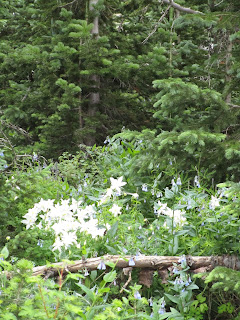
Going into the mountains nearly always lifts me: something of the weight of everyday falls away from me as the elevation climbs. It helps, too, that out of cell-phone range, my usual distractions are virtually non-existent, allowing (forcing) me to stay in the moment with my kids.
When I come down from the mountains, I seem to see with newer eyes. And if I’m not fully eager to enter back into the routines of daily life, at least the routines don’t seem so onerous. (Caveat: I mean temporary retreats: somehow camping more than a night or two leaves me more grumpy than rejuvenated).
I’ve spent a lot of time thinking about why natural spaces speak to me–to us–so strongly.
Some of it, of course, is in the way we learn to see and read landscapes, particularly in America. BYU professor Gregory Clark, in his book Landscapes in America, describes the way Yellowstone was framed in early pamphlets advertising the park, to help visitors to the park experience it as a uniquely American experience. Similarly, art historian Simon Schama argues that we are culturally predispositioned to see landscapes in certain ways.
We’ve inherited—consciously or not—the nineteenth-century American enthusiasm for wilderness. According to Schama, the nineteenth-century view of nature overturned earlier generations’ belief that the eastern forests were a sign of evil and refigured wilderness as something sacred and holy. William Cronon suggests that this reversal came about partly through the confluence of romantic notions of the sublime and the frontier: sublime landscapes were a place where one might meet God, and the frontier was viewed as a place for national renewal. Yet, as Cronon points out, wilderness is also very much a cultural creation.
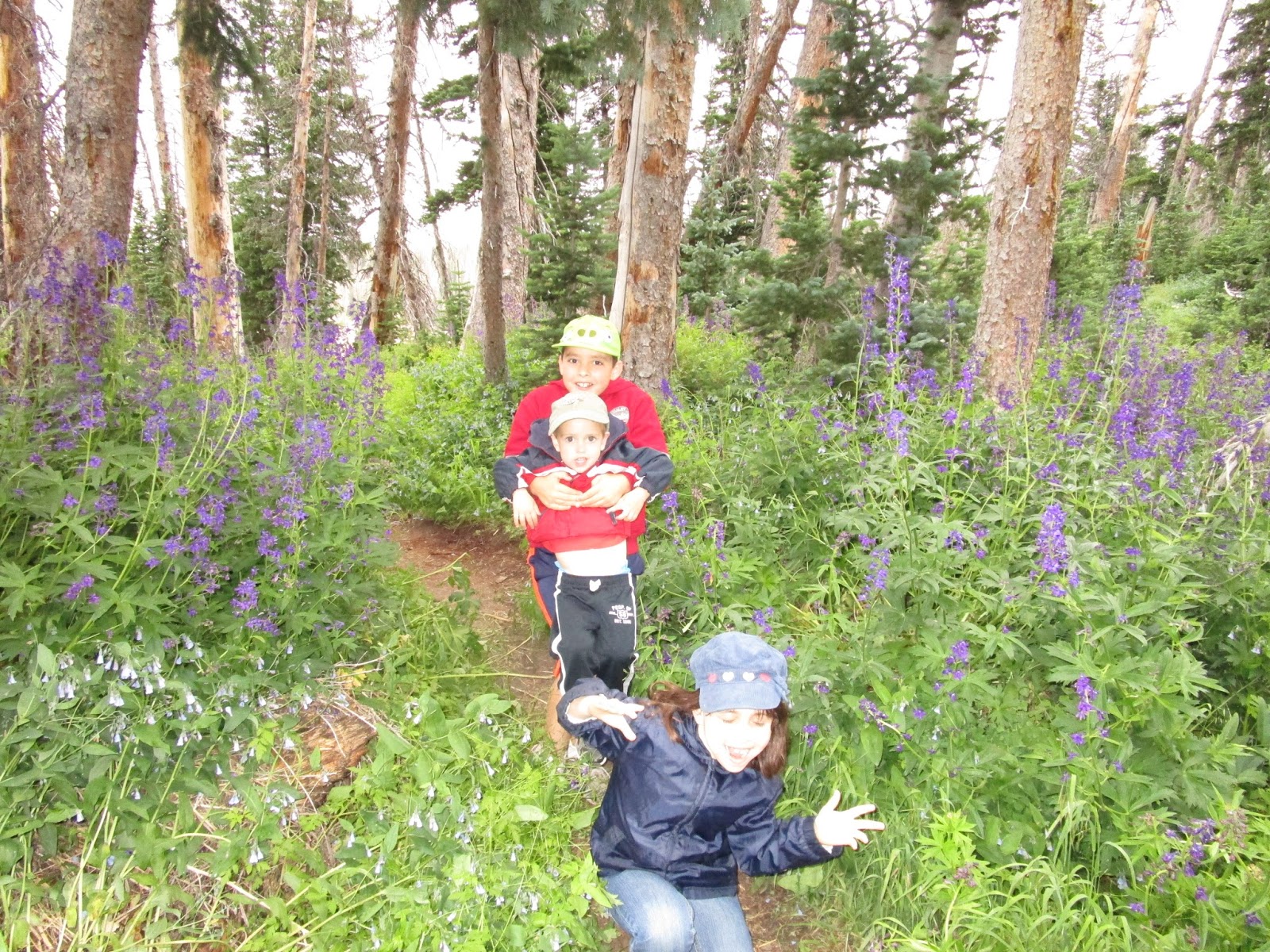
As LDS culture, we revere mountains, which stand akin to temples. We cite Isaiah 2:2, “And it shall come to pass in the last days, that the mountain of the Lord’s house shall be established in the top of the mountains, and shall be exalted above the hills; and all nations shall flow unto it.” We look to a long history of prophets who went into the mountains (Moses, most notably) and emerged transformed.
Under the twin religious and cultural influences, it’s impossible for me to go into the mountains and see anything other than sanctuary. Understanding some of the framework for my experience helps me analyze my reaction–but it doesn’t fully explain it.
I’m not certain I want a full explanation. Sometimes, it’s enough to go into the mountains, wander through fields of flowers, and simply enjoy.

What places move you? Where do you find “sanctuary”?
Cronon did an earlier book, Changes in the Land, about the ecology and landscape that the early Anglo settlers encountered in New England. Turns out it wasn't "wilderness" at all but land that had been managed by the local Native Americans. http://mormoninquiry.typepad.com/mormon_inquiry/2005/11/bushman_on_morm.html
This doesn't surprise me at all. One of the big problems with nineteenth century idealizations of wilderness was the premise of "virgin" land, which helped justify the removal of Native Americans from those spaces.
Hmmm…Rosalyn…you have me wanting to quickly find a mountain! (A little drive from the Tidewater, though). Beautiful prose and fascinating thoughts about cultural disposition towards landscapes! Thank you.
My place of retreat is a tree – whether high or lowland – give me a few trees and I find peace. We live in one of those neighborhoods where they disposed of a lot of trees in building, but our cul de sac has a few of the original trees. I love to look out at them in all seasons. They speak to me! Whether looking up at them from a hammock or looking into their boughs from my bedroom windows. I have to be careful when I say my prayers that I'm not praying to the trees!
Love to visit the west, but after a few weeks, I yearn for the safety of my Virginia trees! Who needs to see a horizon, give me the swaying branches of a deciduous tree and I see God.
Right out of college, I moved to Tempe, Arizona, where what was called a mountain really was a hill to my born-and-bred-in-Utah mentality. I mourned my mountains for years, breathing them in whenever I went back to visit. Ten years after I moved to Arizona, we moved to Southern California where my husband took one look outside our kitchen window and said, "Now I know why you missed your mountains so much." Easy to miss, hard to explain why.
Klm, I lived in Pennsylvania for six years: I can see the appeal to trees too! So peaceful.
I grew up on the prairies; I've lived in the shadows of the Tetons for nearly 40 years – mountains out every window which make me feel as if I'm encircled in the arms of my Father in Heaven. When I get out on the plains/prairies I feel exposed and vulnerable. I really don't relax and feel I'm where I belong until I'm back in this sacred part of His creation.
Just read this from the magnificent Rockies near Estes Oark, CO, and want to shout, AMEN!