
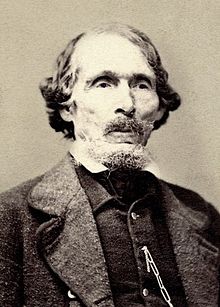
 WW Phelps, who penned “Praise To The Man” that includes the phrase “Sacrifice brings forth the blessings of heaven”.
Since last night we commemorated the atonement, and today the crucifixion of Jesus Christ, I’ve been thinking about sacrfice. In conversation, a man not of our faith commented pretty much everything Mormons consider a “sacrifice” is offered only in exchange for something better. “It’s like you use your agency to barter for better returns from your God. But true sacrifice is only given when made with no expectation of blessings in return”.
His words have given me pause. Since sacrifice is supposed to be a central part of every saint’s life, and since we are indeed under covenant to render sacrifice to the Lord, what, then, does sacrifice look like? If obedience to God’s commandments is less a sacrifice than an exercise in enlightened self-interest, where does our sacrifice occur? And why do we sacrifice?
I think sacrifice is a key element in sanctifying our souls. We render sacrifice by giving up something to God. Loss seems to be the basic element of sacrifice, and there are different kinds: general, universal sacrifices tied to promised blessings (e.g., tithing), and losses that are more lasting, individual and unique (e.g. abuse, financial misfortune, health issues, family problems). These losses don’t feel like they bring any blessings in their wake. They’re just hard things.
But perhaps these hard things are our opportunities for sacrifice?
The difference between the two kinds of loss comes down to a question of consent. We choose to pay tithing or keep commandments, but we have little choice in some of the other losses in our lives. No one asks beforehand if we want to suffer physical, family, professional or financial hardships.
So our attitude toward these more particular, often more difficult or permanent losses, seems to be what determines whether our hardships are made holy, or if they simply remain hardships.
We aren’t asked to consent before the fact to these losses, but we can consent after the fact, and when we do so, we can transform those losses into sacrifice.
When we humbly continue to love God, like Job did despite being stripped of health, wealth, love and success, our sacrifice becomes akin to Abraham’s, when he laid Isaac upon the alter, even though it surely seemed illogical and pointless.
The more illogical the sacrifice is, the more meaningful it can become. Faith does not really enter into the decision to abstain from ingesting poison. People who don’t eat poison aren’t being faithful; they’re just being reasonable. Hence, I may not understand the rationale or agree with a given commandment, but in choosing to conform my will to His, it can become a genuine sacrifice.
If we are commanded to avoid one fruit (seemingly) arbitrarily selected from among a bunch of other fruits, (or to not drink coffee and tea, get multiple piercings or tattoos, or keep the law of chastity, engage in various activities on the sabbath, etc.) then my choice to avoid that forbidden fruit can come from no other source than my commitment to obeying God’s will. Faith only becomes a factor when the intellect is made inoperative–when the command seems petty, nonsensical, or completely random.
Thus when we give our consent to the “losses” that make the least sense, then we are sincerely sacrificial. That’s when we are truly saying “thy will be done” (even if we’re saying it with soul-rending sobs), and our losses can be consecrated and counted as good, and lead to the sanctification of our souls.
Have you ever turned a loss into a sacrifice? What are your thoughts on why we make sacrifices? How does sacrificing change you?
"But true sacrifice is only given when made with no expectation of blessings in return”.
I dunno. I think genuine sacrifice involves relinquishing our own self-interest, but there also needs to be a greater good. An arbitrary illogical loss doesn't cut it. You don't get credited with a sacrifice just for making an out. You also have to advance the runner.
As a convert, I've never been able to wrap my head around: "I do x so I get blessings". That includes sacrifices. It's like I think I can be
in a position to barter with God or make Him owe me something. Daily I'm counting blessings and the abundance of good things in my life – never do I connect it to what I'm doing; only as evidence of how much I'm loved by my Father in Heaven. But Him obligated to me??? No way. (Yes I know the scripture in D&C- no, I don't relate it to me. ) Maybe it's a brain disconnect – I don't know. My husband and his mother on the other hand, whose family goes back to the early days of Nauvoo, believe that's the reason for living the gospel -to get the blessings. I continue to be awe struck that I even have the gospel and all its goodness in my life. Sacrifice, obedience, consecration, all of it – meager, inadequate attempts to pay back. And it never works because Father's love and goodness continues to overshadow and swallow up the little efforts in my life to show my love and gratitude. So weigh my "sacrifices" on a scale with His goodness? I don't even begin to top it.
I don't even begin to tip the scale is what I meant.
When I think of the sacrifices that may be required of me, I think of what 3 Nephi 9:20 and D&C 59:8 refer to: a broken heart and contrite spirit. Pretty much anything else I could be asked to sacrifice is wrapped up in being humble and submissive to God's will. I don't believe a loving Heavenly Father inflicts us with difficulties and trials; He sent us to Earth, knowing mortal life in a telestial world would present us with sufficient challenges to test our obedience and faith. I do believe submissiveness means asking, How would God have me respond in the face of each challenge? What am I supposed to learn from it? What does He want me to become? And above all, I think submissiveness includes a recognition of my own limitations and a willingness to ask for grace when I reach the end of what I'm able to do on my own. Humility isn't self-deprecation or denigration; it's a correct understanding of my flaws, strengths, and eternal potential–and a willingness to ask for divine help when I need it. By bending my will to that of my Father, I become so much more than I'm capable of being on my own. So yes, I will eternally be in His debt. However, I'm finding that I'm not so worried about keeping score, when I'm focusing on living the Gospel as a way to feel connected, on a daily basis, to my loving heavenly Parent. Life is purposeful and joyful even at the same time that it is messy and hard. And day to day, as I seek to sacrifice my own ideas of how my life should be, I'm shown a better way, blessed with tender mercies, and sanctified in spite of my weaknesses.
I love this post. Thank you. The root of sacrifice is to make sacred. To let God make our trials sacred is I think one of the greatest forms of sacrifice…and often one of the most difficult. To put our will about ourselves, our lives, and the lives of those we care about on the altar, as it were, can feel almost impossible.
I used to think about the exchange rate of my 'sacrifices.' I think that is pretty common, and I don't think it's wrong to expect something from God, but perhaps not in the way we often think. To do something to get what *I* want (e.g., I'll read my scriptures and say my prayers and go to the temple so bad things won't happen to me or my loved ones or my friends or others) still isn't giving Him my will and my heart. To give Him my life and my will and then watch and wait as He does amazing things with all things — because HE DOES — that's an exchange rate beyond anything I used to think I wanted.
I still struggle mightily to surrender my will, but I am coming to know this God who gives and gives and gives, even as He allows things to be taken away. He is SO. GOOD.